ITECH SAS Software Explained: Features, Applications, and How It Works in Solar Testing (2026)
Solar technology has advanced rapidly over the past decade, and with that growth comes the need for accurate testing before equipment reaches the market. One of the tools used in professional photovoltaic (PV) testing is ITECH SAS software. Although it isn't widely known outside the renewable energy industry, it plays a vital role in developing and validating modern solar inverters.
Unlike solar design software that estimates energy production or helps plan installations, ITECH SAS software works directly with compatible laboratory equipment to simulate the electrical behavior of real solar panels. This allows engineers to evaluate inverter performance under controlled conditions without relying on actual sunlight.
In this guide, we'll explain what ITECH SAS software is, how it works, its main features, who uses it, and how it compares with other solar-related software.
What Is ITECH SAS Software?
ITECH SAS software is a professional Solar Array Simulator (SAS) application developed by ITECH Electronic Co. It is designed to operate with compatible ITECH programmable DC power supplies, allowing engineers to recreate the electrical output of photovoltaic (PV) panels inside a laboratory.
Instead of installing real solar panels outdoors, engineers can simulate different weather conditions, temperatures, and sunlight levels using software-controlled power supplies. This creates a stable and repeatable testing environment for solar equipment.
The software is primarily used for testing:
Solar inverters
MPPT controllers
DC-DC converters
Power optimizers
Other photovoltaic power electronics
Its biggest advantage is consistency. Since outdoor conditions constantly change, laboratory simulation allows manufacturers to perform identical tests whenever needed.
Why Is Solar Array Simulation Important?
Solar panels never produce a constant amount of electricity. Their output changes throughout the day based on several environmental factors, including:
Sunlight intensity
Panel temperature
Cloud cover
Partial shading
Seasonal weather conditions
Installation angle
Because of these variations, every solar inverter must continuously locate the Maximum Power Point (MPP) where the panel generates the highest possible power.
Testing this behavior outdoors is difficult because weather conditions are unpredictable and impossible to reproduce exactly.
ITECH SAS software solves this problem by generating programmable I-V (Current-Voltage) curves that accurately imitate solar panel performance under virtually any condition.
This enables engineers to complete weeks or even months of testing within a controlled laboratory environment.
How ITECH SAS Software Works
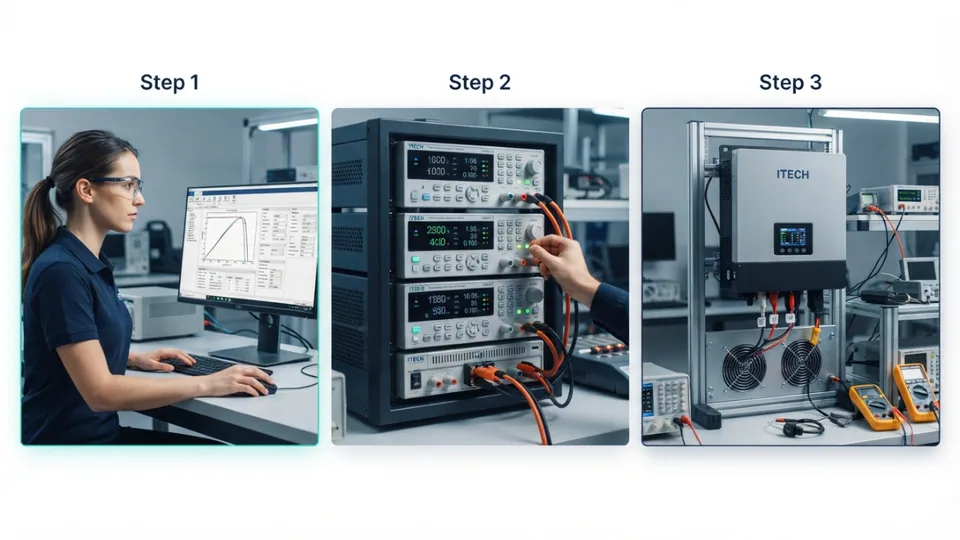
The software itself doesn't generate electrical power. Instead, it communicates with compatible ITECH DC power supplies, which produce programmable electrical output based on the settings created inside the software.
The process is straightforward:
Step | What Happens |
1 | The engineer selects or creates an I-V curve. |
2 | The software sends commands to the connected DC power supply. |
3 | The power supply reproduces the selected solar panel characteristics. |
4 | The inverter or device under test operates as if connected to real solar panels. |
5 | The software records and analyzes the device's performance in real time. |
This setup makes laboratory testing far more reliable than depending on outdoor weather.
Key Features of ITECH SAS Software
Accurate I-V Curve Simulation
One of the software's most important capabilities is generating realistic photovoltaic I-V curves.
Engineers can configure simulations using variables such as:
Solar cell technology
Temperature
Solar irradiance
Fill factor
Open-circuit voltage
Maximum power point values
The software can also store multiple predefined curves for different testing scenarios.
MPPT Performance Testing
Maximum Power Point Tracking (MPPT) is one of the most important functions inside a solar inverter.
ITECH SAS software allows engineers to monitor how efficiently an inverter follows the maximum power point while conditions change dynamically.
Built-in testing profiles support several internationally recognized standards, helping manufacturers verify product performance before certification.
Shadow Simulation
Real-world solar installations rarely receive perfectly even sunlight.
Trees, buildings, chimneys, and nearby structures often create partial shading that changes the electrical characteristics of solar panels.
Shadow Mode reproduces these complex conditions, allowing engineers to evaluate whether an inverter can correctly locate the true maximum power point instead of becoming trapped at a lower local peak.
This feature is particularly valuable for improving inverter efficiency in challenging installations.
Table Mode
For advanced testing, engineers can manually create custom I-V curves using thousands of data points.
This level of precision is useful when evaluating specialized hardware or recreating unusual operating conditions that standard templates cannot represent.
List Mode
List Mode automates long-duration testing by switching between multiple predefined I-V curves.
Instead of manually changing settings throughout a test, engineers can simulate an entire day of changing sunlight automatically.
This saves considerable testing time while improving repeatability.
Supported Testing Standards
ITECH SAS software includes support for several widely recognized photovoltaic testing standards.
Standard | Purpose |
EN50530 | MPPT efficiency testing for grid-connected PV inverters |
Sandia Test Profile | Solar inverter performance evaluation |
NB/T32004 | Chinese photovoltaic inverter testing standard |
CGC/GF004 | Grid-connected PV testing |
CGC/GF035 | Additional certification testing requirements |
Having these standards built into the software reduces manual configuration and helps ensure consistent testing procedures.
Beyond standard I-V curve simulation, ITECH SAS software also supports advanced testing features designed for research laboratories and commercial product development. Engineers can automate complete testing cycles, create highly detailed simulation profiles, and evaluate how equipment performs under changing environmental conditions without requiring constant manual adjustments.
For projects that demand precise electrical behavior, the software offers Table Mode. Instead of relying on predefined solar panel models, engineers can manually define custom I-V curves using thousands of data points. This is particularly useful for testing unique photovoltaic modules, experimental technologies, or specialized research applications where standard simulation models are not sufficient.
Another useful feature is List Mode, which automates long-duration testing by running multiple I-V curves in sequence. Engineers can simulate changing weather throughout the day by transitioning between different sunlight and temperature conditions automatically. This removes the need for manual intervention while improving testing consistency.
Organizations testing modern string inverters often require multiple independent inputs to be evaluated at the same time. The SAS1000M version supports multi-channel operation, allowing compatible ITECH power supplies to control multiple independent solar array simulations simultaneously. This capability is especially valuable for large commercial inverters that include several MPPT channels.
Compatible Hardware
ITECH SAS software is designed specifically for compatible programmable DC power supplies manufactured by ITECH. Rather than functioning as a standalone simulator, the software works together with this hardware to generate realistic photovoltaic output.
Some commonly supported hardware includes:
Hardware Series | Primary Purpose |
IT6000B | High-power programmable DC power supply |
IT6000C | Advanced programmable DC source |
IT6500C | Precision DC power testing |
IT-M3400 | Modular programmable power supply |
IT-M3600 | High-performance modular testing platform |
Together, the software and hardware create a complete laboratory solution capable of reproducing real solar panel behavior with high accuracy.
Who Uses ITECH SAS Software?
ITECH SAS software serves a specialized audience rather than general solar installers or homeowners. It is primarily used in industries where photovoltaic equipment must be thoroughly tested before deployment.
The following organizations commonly use the software:
Industry | Typical Use |
Solar inverter manufacturers | Product development and MPPT verification |
Research laboratories | Renewable energy research and algorithm testing |
Certification organizations | Compliance testing against international standards |
Universities | Engineering education and renewable energy research |
Power electronics companies | Testing DC converters, optimizers, and inverter components |
Because the software creates repeatable laboratory conditions, it allows engineers to compare results accurately across multiple test cycles.
ITECH SAS Software vs Other Solar Software
The term "solar software" covers several categories of applications, and each serves a different purpose. ITECH SAS software focuses on hardware testing, while many popular solar programs concentrate on system design or performance modeling.
Software | Main Purpose | Best For |
ITECH SAS | Solar array simulation with real hardware | Engineers and testing laboratories |
PVsyst | Energy production simulation | Solar system designers |
SAM (System Advisor Model) | Performance and financial analysis | Researchers and project developers |
HelioScope | PV layout and shading analysis | Solar installers and EPC companies |
MATLAB/Simulink | Algorithm development and simulation | Academic and engineering research |
If your goal is to estimate energy production for a rooftop installation, software such as PVsyst or HelioScope is the better choice. However, if you need to verify how a physical inverter performs under laboratory conditions, ITECH SAS software provides the specialized tools required for accurate testing.
Technical Highlights
When combined with compatible ITECH programmable power supplies, the SAS1000 platform supports advanced testing capabilities suitable for both laboratory research and industrial environments.
Specification | Details |
Maximum Output Voltage | Up to 2,250 V |
Maximum Output Current | Up to 2,040 A |
Scalable Output Power | Up to 1,152 kW |
I-V Curve Resolution | Up to 4,096 data points |
Stored Curves | Up to 100 simulation profiles |
Multi-Channel Support | Up to 20 channels (SAS1000M) |
Supported Standards | EN50530, Sandia, NB/T32004, CGC/GF004, CGC/GF035 |
These specifications make the platform suitable for everything from small development laboratories to large-scale manufacturing test facilities.
Is There a Free Version?
ITECH SAS software is not available as a free standalone application. It is developed as part of ITECH's professional testing ecosystem and is intended for use with compatible hardware.
Organizations interested in using the platform typically purchase supported equipment through authorized distributors. Depending on the region, demonstrations, product evaluations, or trial configurations may be available by contacting ITECH directly.
Students and researchers looking for general photovoltaic modeling without hardware interaction may consider alternatives such as MATLAB Simulink models or NREL's System Advisor Model (SAM). While these applications are useful for simulation and analysis, they do not replace hardware-based solar array testing.
Final Thoughts
ITECH SAS software is a specialized engineering solution built for accurate photovoltaic testing in laboratory environments. Instead of relying on unpredictable outdoor conditions, engineers can reproduce realistic solar panel behavior, evaluate inverter performance, verify MPPT efficiency, and perform certification testing using repeatable simulation profiles.
Its integration with programmable ITECH DC power supplies, support for international testing standards, and advanced simulation features make it a valuable platform for manufacturers, research institutions, certification laboratories, and power electronics engineers working with solar technologies.
Although it is not intended for everyday solar system design or residential planning, it remains an important tool for organizations developing and validating photovoltaic equipment before it reaches the market.
Disclaimer: This article is provided for informational and educational purposes only. We are not affiliated with ITECH Electronic Co., Ltd. (ITECH SAS), nor are we an authorized distributor or representative of the company. All trademarks, product names, and brand names mentioned belong to their respective owners. Any references are made solely to explain the software and its intended use.