ERP Software for Oil and Gas Industry: A Practical Guide
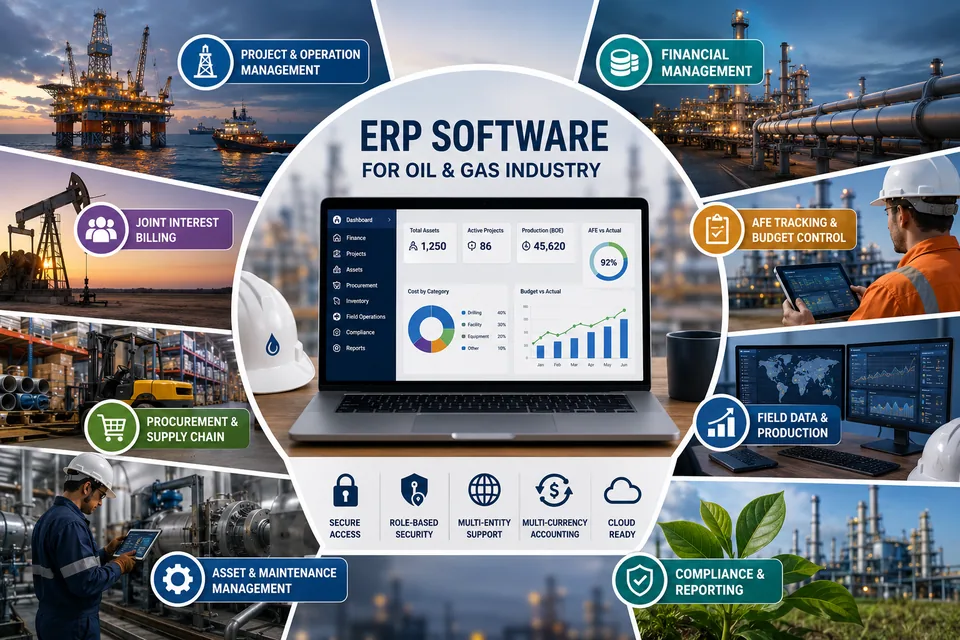
Few industries operate with as many moving parts as oil and gas. A single company might be managing exploration budgets, drilling schedules, remote asset maintenance, joint venture partnerships, environmental compliance reporting, and multi-entity financials, often all at once, and often across upstream, midstream, and downstream operations that each run on different timelines and cost structures.
Trying to manage that complexity with spreadsheets and disconnected point solutions tends to break down fast. That's the core reason ERP software for the oil and gas industry exists: to bring finance, operations, procurement, assets, and field activity into one connected system instead of dozens of disconnected ones.
This guide covers what oil and gas ERP software actually does, the industry-specific features that separate it from generic ERP platforms, and what to weigh when evaluating a system for your organization. If part of your evaluation process involves converting vendor proposals, compliance documents, or reporting templates between formats, tools like PDF Tools and Text Tools from Toolsimpli can help streamline that side of the process.
What Is ERP Software for Oil and Gas?
Oil and gas ERP software is a business management system that connects finance, operations, projects, purchasing, inventory, assets, field activity, and reporting into a single platform. Rather than running separate systems for accounting, maintenance, and field data, the ERP acts as a central system of record that teams across departments, entities, and locations can pull from and report against.
What separates oil and gas ERP from general-purpose ERP is the industry-specific functionality built around how energy companies actually operate. Generic ERP systems are usually built around manufacturing, retail, or standard services workflows. Oil and gas companies need something that also understands joint interest billing, authorization for expenditure (AFE) tracking, lease and royalty accounting, and production data tied to specific wells or assets, often in remote locations.
Core Features of Oil and Gas ERP Software
Financial Management and Joint Interest Billing (JIB)
Oil and gas projects are frequently funded by multiple partners sharing costs and revenue across a well, lease, or exploration project. Joint interest billing functionality allows the ERP to accurately split costs and distribute revenue among partners, track partner balances, and generate JIB statements automatically instead of through manual reconciliation.
Authorization for Expenditure (AFE) Tracking
Before major capital projects begin, oil and gas companies typically require formal approval and budget tracking through AFEs. ERP systems built for this industry track AFE budgets against actual spend in real time, flagging cost overruns early rather than after a project closes out.
Asset and Equipment Lifecycle Management
Rigs, pumps, compressors, and pipeline infrastructure represent enormous capital investment, and much of it operates in remote or difficult-to-access locations. ERP platforms with asset management modules track maintenance schedules, equipment status, and lifecycle costs, helping prevent unplanned downtime and extending asset life through better-timed maintenance.
Supply Chain and Vendor Management
Extraction and production projects depend on reliable delivery of equipment, materials, and services, often from vendors spread across multiple regions or countries. ERP supply chain modules track supplier performance, manage procurement workflows, and help logistics teams adjust routing when delays or shortages arise.
Production and Field Data Management
Upstream operations generate continuous field data: production volumes, well performance, equipment readings, and more. ERP systems built for oil and gas typically integrate with field data sources and SCADA systems, giving finance and operations teams a connected view of production activity tied directly to cost and revenue tracking.
Regulatory and Environmental Compliance
Energy companies operate under significant regulatory oversight covering safety, emissions, and environmental impact. ERP platforms support compliance through built-in reporting tools, audit trails, and documentation tracking that align with the reporting formats regulators require.
Multi-Entity and Multi-Currency Financial Consolidation
Larger oil and gas operators frequently manage multiple legal entities, joint ventures, and international operations. ERP systems designed for this industry support multi-entity consolidation and multi-currency accounting, giving leadership a consolidated financial view without manual spreadsheet reconciliation across entities.
How Oil and Gas ERP Differs by Company Size
Feature Priority | Smaller Operators | Mid-Size Companies | Large Enterprises |
|---|---|---|---|
Deployment Preference | Cloud, lower upfront cost | Cloud or hybrid | Cloud or on-premise, high customization |
Core Focus | Basic accounting, inventory, simplified JIB | JIB, AFE tracking, multi-entity reporting | Full upstream-to-downstream integration, complex consolidation |
Typical Platforms Considered | Sage Intacct, Sage 100, Odoo | NetSuite, Dynamics 365 Business Central | Dynamics 365 F&O, Oracle ERP Cloud, SAP, Infor CloudSuite |
Implementation Timeline | Weeks to a few months | Several months | Often a year or more for full rollout |
Integration Needs | Basic accounting and inventory sync | SCADA, CRM, field service integration | Deep integration across specialized systems |
This table reflects general tendencies rather than strict rules. Company size matters less than operational complexity: a smaller operator running complex joint ventures across multiple partners may need more sophisticated JIB and AFE functionality than a larger company with simpler ownership structures.
Specialized Oil and Gas Software vs. General ERP
One important distinction worth understanding before evaluating vendors: some companies use ERP as their central operating platform, while others use ERP purely as the financial system of record, connected to specialized operational software for things like drilling engineering, reservoir modeling, or pipeline monitoring.
There's no universally correct approach. Smaller and mid-size operators often benefit from an ERP that handles both financial and operational workflows in one system, reducing the number of platforms staff need to learn. Larger, more complex operators frequently run a hybrid setup, using ERP for financial consolidation and reporting while specialized engineering and operational tools handle the technical work that general ERP platforms aren't built for.
What to Look for When Evaluating an ERP Vendor
Choosing the right platform involves more than comparing feature lists. A few questions worth working through during vendor evaluation:
Does the platform offer native joint interest billing and AFE tracking, or would these need to be built through customization or third-party add-ons? Native functionality is generally more stable and less costly to maintain long term.
How well does the ERP integrate with existing field systems, SCADA, CRM, and accounting tools already in use? Integration gaps often become the most expensive part of an implementation.
What security and compliance features are built in? Look for data encryption, multi-factor authentication, role-based access control, and regular security updates from the vendor.
What does the total cost of ownership look like, not just licensing, but implementation, training, and ongoing support? Oil and gas ERP implementations can range widely depending on company size and complexity.
Does the vendor have direct experience with oil and gas operations, or is the industry-specific functionality a general add-on to a broader platform? Vendors with deep sector experience tend to anticipate workflow needs that generic platforms miss.
Why the Right ERP Matters Beyond Efficiency
It's easy to frame ERP adoption purely as an efficiency play, and that's certainly part of it. But in an industry defined by cost volatility, complex partnerships, and heavy regulatory oversight, having accurate, real-time financial and operational data isn't just about saving time. It directly affects how quickly a company can respond to a cost overrun, a compliance deadline, or a shift in commodity prices.
Companies running fragmented systems often discover problems well after the fact, once the financial impact has already compounded. A connected ERP system shortens that gap considerably, giving finance, operations, and field teams a shared, current view of what's actually happening across the business.
For teams managing the documentation side of an ERP rollout, from vendor comparison sheets to compliance reporting templates, general-purpose tools like Image Tools and Developer Tools from Toolsimpli can help handle file conversions and lighter technical tasks without requiring a dedicated IT project. For more guides on evaluating business software, visit the Toolsimpli Blog.
Frequently Asked Questions
What is ERP software for the oil and gas industry?
It's a business management system that connects finance, operations, procurement, assets, and field data into a single platform, with industry-specific functionality for joint interest billing, AFE tracking, and production data management.
How is oil and gas ERP different from general ERP software?
Oil and gas ERP includes industry-specific modules that general ERP platforms typically lack, such as joint interest billing, AFE tracking, lease and royalty accounting, and integration with field production data and SCADA systems.
What size companies typically need oil and gas ERP software?
Companies of nearly any size can benefit, though the right platform depends more on operational complexity, such as joint venture structures and multi-entity reporting needs, than on company size alone.
Should oil and gas companies use ERP for operational workflows too, or just finance?
It depends on company size and complexity. Smaller and mid-size operators often use ERP for both financial and operational needs, while larger companies frequently pair ERP with specialized engineering or operational software for technical workflows.
What features matter most when evaluating an oil and gas ERP vendor?
Native joint interest billing and AFE tracking, integration capabilities with existing field and accounting systems, strong security and compliance features, and vendor experience specific to the energy sector.
How long does an oil and gas ERP implementation typically take?
Timelines vary significantly by company size and scope, ranging from a few months for smaller operators to a year or more for large enterprises implementing full upstream-to-downstream integration.
Related posts
Recovery Home Management Software Solutions: What Operators Need to Know
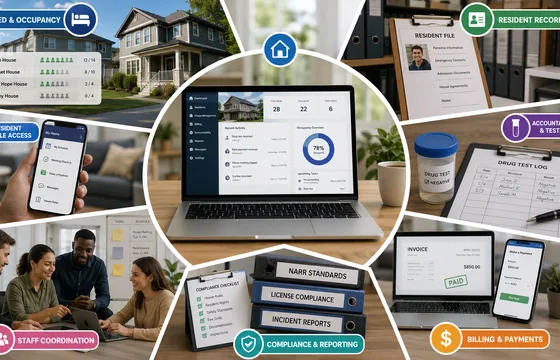
This is exactly the gap that recovery home management software solutions were built to close. Rather than stitching together spreadsheets, paper intake forms, and a separate payment app, purpose-built platforms bring resident records, billing, compliance documentation, and day-to-day house operations into one system.

Rippling HR Software Market Share in 2026: What the Numbers Really Show
Rippling isn't the biggest player in HR software by raw market share, and depending on which report you read, it may rank anywhere from third to well down the list. What's harder to argue with is the growth curve. Revenue crossing a billion dollars, tens of thousands of customers, and a steady stream of new features point to a company that's earned its spot on most shortlists.

What Is Immorpos35.3 Software? Features, Benefits, and Business Applications
Managing business operations becomes more challenging as a company grows. Teams often use multiple applications for communication, task management, reporting, and file storage. While these tools may work independently, they can create confusion when information is spread across different platforms. Employees spend extra time searching for data, updating spreadsheets, and following up on pending tasks instead of focusing on meaningful work.
How to Classify Software Application Components (A Practical Guide)
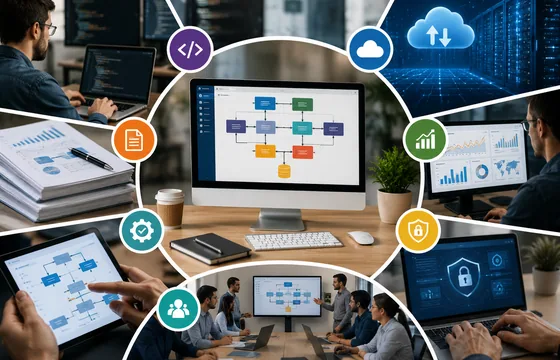
If you've ever opened a software architecture diagram and felt a little lost, you're not alone. Terms like "presentation layer," "middleware," and "data component" get thrown around a lot, but they don't always come with a clear explanation. This guide breaks down exactly how software application components are classified, why the classification matters, and how to apply it to real systems you might be working with today.
ATEN CC2000 Lite Plus Pack Centralized Management Software Explained
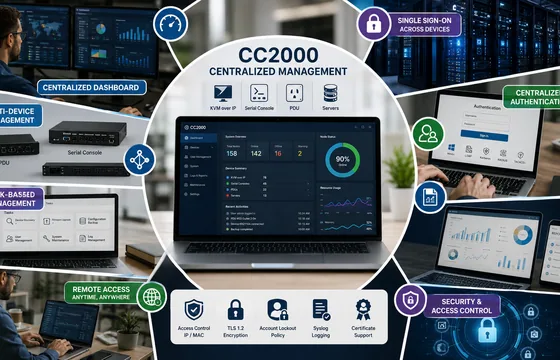
Managing a growing IT environment usually means juggling KVM over IP switches, serial console servers, power distribution units, and a mix of physical and virtual servers, often across multiple locations. Without a single point of control, IT teams end up logging into separate interfaces for each device type, which slows down troubleshooting and makes consistent security policy nearly impossible to maintain.